
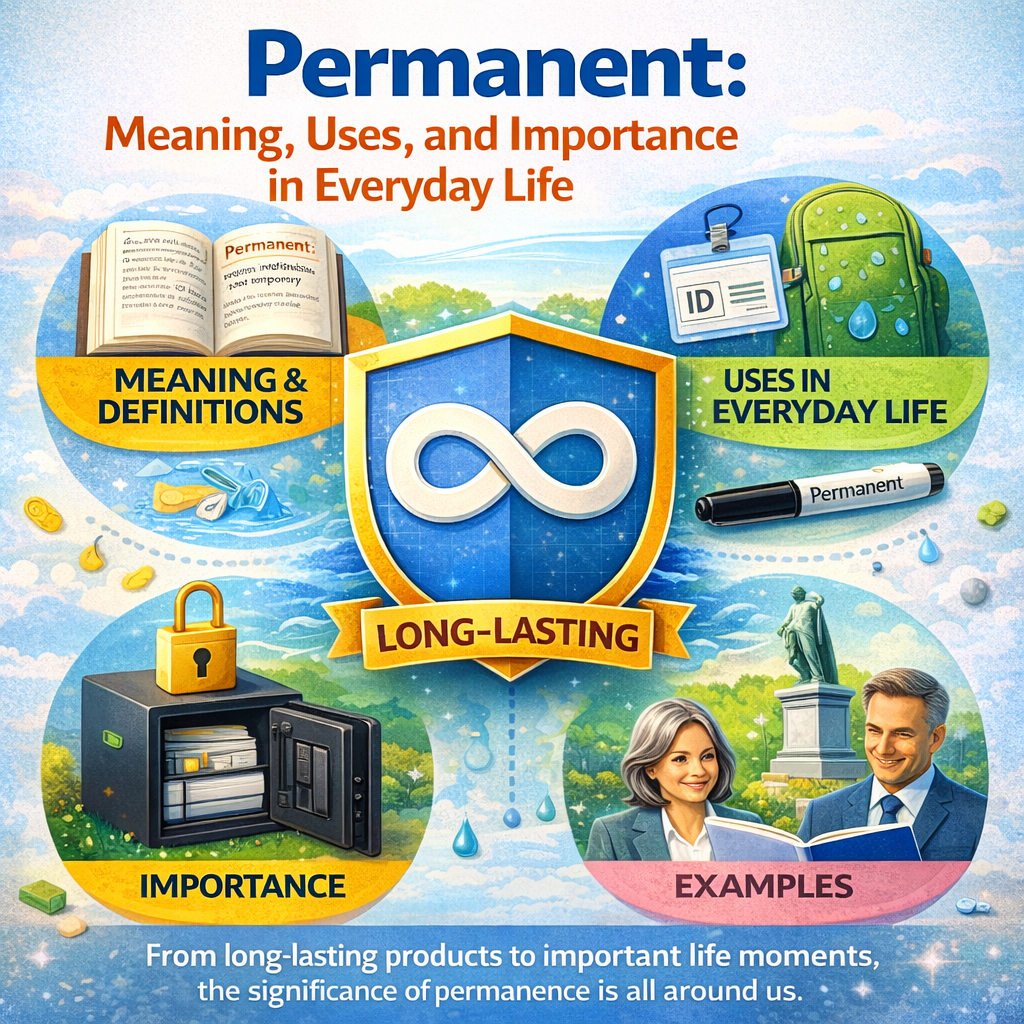
The word permanent is widely used in everyday language to describe something that is lasting, stable, and not intended to change or disappear over time. From permanent jobs and housing arrangements to permanent solutions and long-term decisions, the concept plays an important role in many aspects of life. Understanding what permanent truly means can help individuals make more informed decisions, especially when dealing with commitments that may have lasting consequences.
In modern society, people often face choices between temporary and permanent options. While temporary solutions may offer flexibility, permanent choices usually provide stability and long-term security. Exploring the meaning, uses, and importance of the concept of permanent allows us to better appreciate how long-lasting decisions shape our personal, professional, and social lives.
Understanding the Meaning of Permanent
At its core, the term permanent refers to something that remains unchanged for a long period of time or indefinitely. It is often used to describe conditions, decisions, or objects that are intended to endure rather than disappear or be replaced.
In many contexts, permanence is associated with reliability and durability. A permanent structure, for example, is designed to last for years, while a permanent position in a workplace indicates long-term employment rather than a temporary contract.
The concept also reflects a sense of stability. When something is described as permanent, it suggests that it has a fixed place or role that is not expected to change easily.
Permanent vs Temporary
To fully understand the idea of permanence, it is helpful to compare it with its opposite—temporary. Temporary situations exist for a limited time and are expected to change or end. Permanent situations, on the other hand, are intended to remain stable and continuous.
For example, a temporary job might last only a few months or until a project is completed. A permanent job, however, usually provides ongoing employment and long-term career opportunities.
Similarly, temporary housing arrangements may be used during travel or relocation, while permanent housing represents a long-term place of residence. These distinctions highlight how permanence is often associated with commitment and long-term planning.
Permanent in Personal Life
The concept of permanent appears frequently in personal decisions and life choices. Many individuals seek permanent solutions when making important life plans such as choosing a career, buying a home, or building long-term relationships.
Permanent relationships, such as marriage or lifelong friendships, are based on commitment and trust. These connections provide emotional support and stability, helping individuals navigate life’s challenges.
Permanent decisions in personal life often require careful consideration because they may influence future opportunities and experiences. While some decisions can be changed later, others may have lasting effects.
Permanent in the Workplace
In professional environments, the idea of permanence often relates to employment status and organizational roles. A permanent position typically refers to a job with no fixed end date, offering employees long-term stability and career growth opportunities.
Permanent employees may receive additional benefits such as health insurance, retirement plans, and professional development opportunities. These advantages encourage employees to remain committed to their organizations and contribute to long-term success.
Employers also benefit from permanent staffing arrangements. Retaining experienced employees allows companies to build institutional knowledge, maintain productivity, and strengthen workplace culture.
Permanent in Infrastructure and Development
Another important use of the concept of permanent appears in construction, engineering, and infrastructure development. Permanent structures are designed to remain in place for many years and withstand environmental conditions.
Buildings, bridges, roads, and public facilities are examples of permanent infrastructure. These structures support economic development, transportation, and community growth.
When engineers design permanent structures, they consider durability, safety, and sustainability. Long-term planning ensures that these projects continue to serve communities effectively for generations.
Permanent in Education and Knowledge
Education also reflects the importance of permanence. Knowledge and skills gained through education often provide permanent benefits that influence a person’s career and personal development.
Learning fundamental skills such as reading, writing, and critical thinking creates a lasting foundation for future growth. These abilities remain valuable throughout a person’s lifetime.
Educational achievements, such as degrees or certifications, also represent permanent records of academic accomplishment. They can open doors to professional opportunities and contribute to long-term success.
Permanent Solutions in Problem-Solving
When individuals or organizations face challenges, they often seek permanent solutions rather than temporary fixes. Permanent solutions address the root cause of a problem and aim to prevent it from recurring.
For example, repairing structural damage in a building requires more than a quick patch. Engineers must identify the underlying issue and implement a lasting solution to ensure safety.
In business and management, permanent solutions may involve improving processes, strengthening communication, or implementing new strategies. These changes help organizations achieve long-term stability and growth.
Challenges of Permanent Decisions
While permanence offers stability, it also presents challenges. Permanent decisions can limit flexibility if circumstances change unexpectedly.
For instance, choosing a permanent career path may become difficult if industries evolve or new opportunities arise. Similarly, permanent infrastructure projects must adapt to changing environmental conditions and technological advancements.
Because of these challenges, individuals and organizations must carefully evaluate the long-term consequences of permanent decisions. Planning and foresight play a crucial role in ensuring that these choices remain beneficial over time.
The Importance of Balance
Balancing permanence with adaptability is essential for success in many areas of life. While permanent commitments provide stability, maintaining the ability to adjust to new situations is equally important.
For example, businesses may create permanent strategies while still remaining open to innovation and change. Individuals may pursue long-term goals while continuing to learn and develop new skills.
This balance allows people and organizations to benefit from the security of permanence while remaining prepared for future challenges.
Conclusion
The concept of permanent holds significant meaning in everyday life, influencing decisions related to relationships, careers, infrastructure, education, and problem-solving. Permanence represents stability, durability, and long-term commitment, making it an important factor in planning for the future.
While permanent choices often provide security and continuity, they also require careful consideration because of their lasting impact. By understanding the meaning and implications of permanence, individuals and organizations can make thoughtful decisions that support long-term success.
Ultimately, the value of permanence lies in its ability to create reliable foundations upon which growth, development, and meaningful experiences can be built.
