
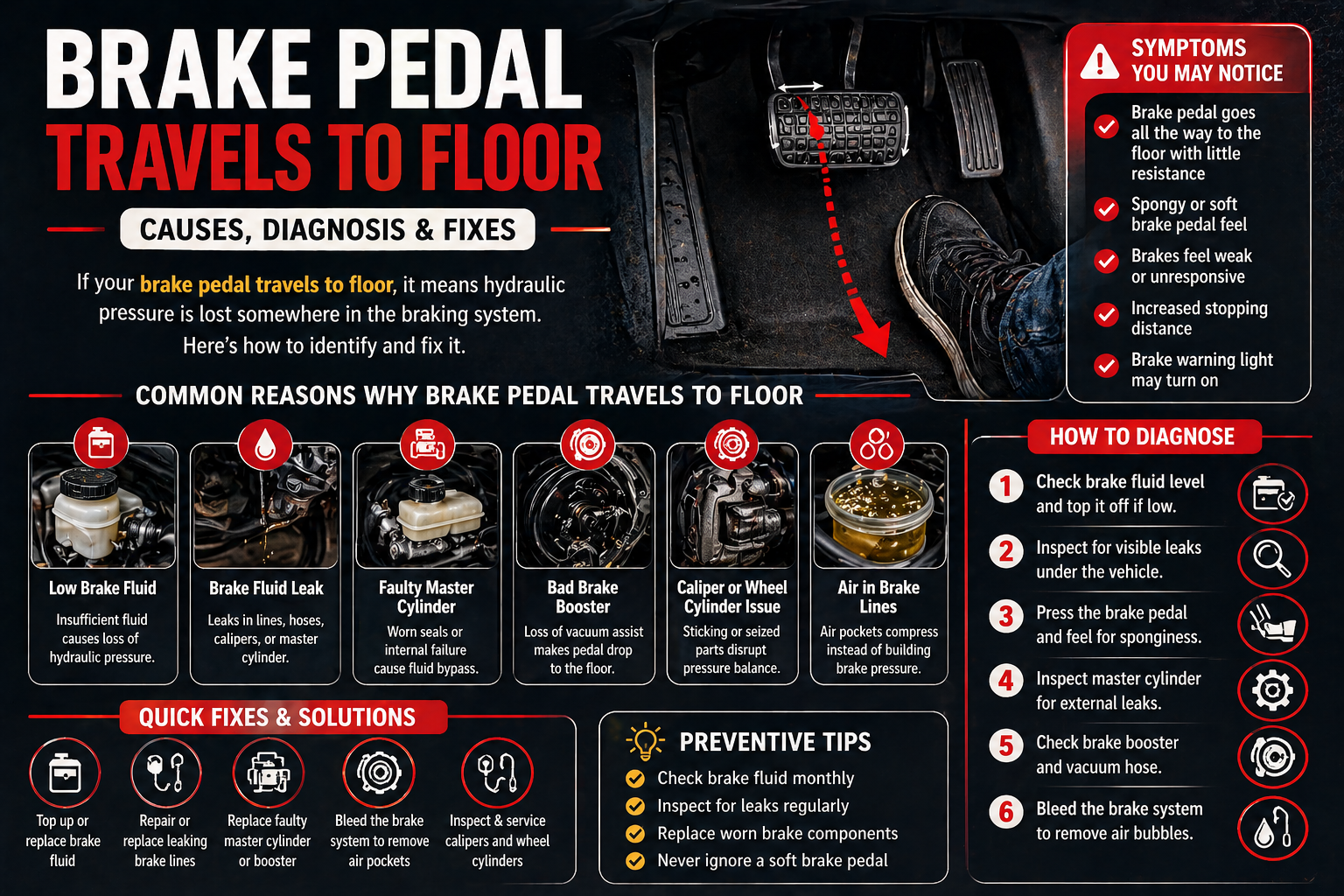
Nothing strikes fear into a driver’s heart like pressing the brake pedal only to feel it sink unusually low. When your brake pedal travels to the floor without resistance, your vehicle is telling you something is dangerously wrong.
This comprehensive guide covers every scenario: why does my brake pedal go to the floor but fluid is full, brake pedal goes to floor but still stops, brake pedal goes to floor then pumps up, why does my brake pedal go to the floor when the engine is running, and brake pedal travels to floor when parked. Don’t ignore these warnings — your safety depends on understanding the causes.
Why does my brake pedal go all the way to the floor even though the brake fluid is full?
One of the most puzzling situations drivers face is: why does my brake pedal go to the floor but fluid is full? You check the reservoir, see brake fluid at the proper level, yet the pedal still sinks. How is this possible?
Common Causes When Fluid Is Full:
| Cause | Explanation |
| Failing master cylinder | Internal seals leak fluid past the pistons without external fluid loss |
| Brake booster failure | Vacuum leak allows pedal to sink under pressure |
| Air in the brake lines | Compressible air replaces incompressible fluid (fluid level remains normal) |
| Bad brake hose | Internal hose bulge absorbs pressure without external leak |
| ABS module malfunction | Internal valve leak bypasses pressure |
Master Cylinder: The Most Likely Culprit
Why does my brake pedal go to the floor but fluid is full on the master cylinder, here’s what happens: The master cylinder has two internal chambers with rubber seals. When these seals wear out, fluid slips past them when you press the pedal. The fluid recirculates internally — never leaving the reservoir — so the fluid level appears full. The result? A brake pedal travels to the floor with no visible leak anywhere.
Diagnostic test: With the engine off, pump the brake pedal several times. If the pedal feels firm on the first pump but slowly sinks when you hold pressure, your master cylinder is failing.
Brake Pedal Goes to Floor But Still Stops – Is That Possible?
Many drivers report: brake pedal goes to floor but still stops the vehicle. How can stopping power remain when the pedal is on the floor?
Why Brake Pedal Goes to Floor But Still Stops Happens:
Your braking system has dual hydraulic circuits (front/rear split or diagonal split). If one circuit fails, the other can still provide reduced stopping power. You’ll feel a brake pedal travel to the floor because half the system has no pressure, but the remaining functional circuit allows the car to eventually stop — though stopping distances increase dramatically.
Dangers of Brake Pedal Goes to Floor But Still Stops:
- Stopping distance can double or triple
- Vehicle may pull sharply to one side
- Emergency stops become nearly impossible
- Brake fade occurs rapidly under repeated use
Warning: Even if your brake pedal goes to the floor but still stops, do not drive. The remaining circuit could fail without warning. Tow the vehicle to a mechanic.
Brake Pedal Goes to Floor Then Pumps Up – What It Means
Another common symptom is when your brake pedal goes to the floor then pumps up after one or two quick presses. This pattern reveals specific problems.
Causes of Brake Pedal Goes to Floor Then Pumps Up:
1. Air in the Brake Lines – Air compresses where fluid should not. First press compresses air (pedal to floor). Subsequent pumps compress the air further, building some pressure before the pedal firms up. Bleeding the brakes solves this.
2. Worn Brake Pads Excessively – Severely worn pads force caliper pistons far outward. The first pedal stroke moves pistons into contact. The second stroke builds actual pressure. If your pads are metal-on-metal, replace them immediately.
3. Rear Brake Adjustment (Drum Brakes) – Drum brakes with automatic adjusters that have failed will cause a low pedal on first application. Pumping takes up the slack. Manual adjustment or new adjusters are needed.
4. Collapsed Rubber Brake Hose – An internal flap in a brake hose can act as a one-way valve. First press pushes fluid past the flap. Released pressure allows the flap to close, trapping fluid. Second press now has a blocked line — pedal feels artificially firm.
Differential Diagnosis:
| Symptom | Likely Cause |
| Pedal slowly sinks to floor then pumps up | Master cylinder internal leak |
| Pedal goes to floor on first press, firms on second | Air in lines or worn pads |
| Pedal pumps up but never gets fully hard | Brake hose collapse or ABS issue |
| Pedal pumps up only when engine running | Booster or vacuum problem |
Brake Pedal Travels to Floor When Parked – Engine Off vs. On
The brake pedal travels to the floor when parked and can behave differently depending on whether the engine is running. Let’s break down both scenarios.
Brake Pedal Travels to Floor When Parked (Engine Off)
With the engine off, the brake booster has no vacuum assist. The pedal should feel very firm. If the brake pedal travels to floor when parked with the engine off:
- Master cylinder failure (most common)
- External brake fluid leak (check under the car)
- Failed brake line or caliper seal
Why Does My Brake Pedal Go to the Floor When the Engine Is Running?
If you’ve asked why does my brake pedal go to the floor when the engine is running, you’ve noticed the problem only appears with vacuum assist active.
Causes When Engine Is Running Only:
| Cause | How to Test |
| Bad brake booster | With engine off, pump pedal to deplete vacuum. Hold pressure and start engine. Pedal should drop slightly. No drop = booster failing |
| Booster vacuum leak | Hissing sound under dash or near booster. Leak allows air in, reducing assist and causing a sinking pedal |
| Internal master cylinder leak | More noticeable with engine running because booster multiplies the leak’s effect |
| ABS pump bypass | Internal ABS valve leak only appears when system is powered |
Step-by-Step Test for “Why Does My Brake Pedal Go to the Floor When the Engine Is Running”:
- With engine off, pump brake pedal 3-4 times until firm
- Hold firm pressure on the pedal
- Start the engine
- Normal result: Pedal drops slightly (about ¼ inch) as vacuum builds
- Abnormal result: Pedal slowly sinks to the floor or drops dramatically
If the pedal sinks only when the engine runs, your booster or master cylinder has an internal failure that vacuum pressure exposes.
Brake Pedal Travels to Floor: The Master Cylinder Deep Dive
The master cylinder is the most common answer to brake pedal travels to floor. Understanding how it fails helps you diagnose confidently.
How a Master Cylinder Works:
- Converts pedal pressure into hydraulic pressure
- Contains two separate pistons (primary and secondary)
- Seals prevent fluid bypass between chambers
Failure Modes:
Internal Seal Failure – Fluid pushes past seals during pedal application. No external leak. The pedal slowly sinks under steady pressure.
Primary Cup Failure – The main seal between reservoir and pressure chamber fails. The pedal goes to the floor instantly.
Bore Scoring – Corrosion or debris scratches the cylinder wall. Seals cannot maintain pressure. Intermittent sinking pedal.
Can You Drive with a Failing Master Cylinder?
Absolutely not. When the brake pedal travels to the floor due to master cylinder failure, you have no reliable braking. One stop may work; the next may not.
Brake Fluid Leaks: External vs. Internal
Why does my brake pedal go to the floor but fluid is full indicates an internal leak, external leaks are easier to spot but less common.
External Leak Locations:
- Brake lines (rust or damage)
- Caliper piston seals
- Wheel cylinder seals (drum brakes)
- Master cylinder to reservoir grommets
- ABS module connections
What to Look For:
- Puddles under the vehicle (clear to amber fluid)
- Wet, oily residue on brake components
- Consistently dropping fluid level over days/weeks
- Burning smell from fluid dripping on exhaust
Internal Leak Signs (No Fluid Loss):
- Brake pedal travels to floor but reservoir stays full
- Pedal slowly sinks under constant pressure
- No visible drips anywhere
- Brake warning light may illuminate
Brake Pedal Goes to Floor Then Pumps Up: Bleeding Your Brakes
If air in the lines causes your brake pedal to go to the floor then pumps up, bleeding the brakes is the solution.
Tools Needed:
- Use brake fluid that is DOT 3, 4, or 5.1, as stated in your owner‘s manual.
- Clear plastic tubing
- Jar or bottle
- Box-end wrench (8mm or 10mm typically)
- Helper (or one-person bleeder kit)
Bleeding Order (Most Vehicles):
- Right Rear (furthest from master cylinder)
- Left Rear
- Right Front
- Left Front (closest to master cylinder)
How to Bleed:
- Top off brake fluid reservoir
- Attach tubing to bleeder screw, other end in jar with fluid
- Helper pumps brake pedal 3-4 times then holds down
- Open bleeder screw slightly — fluid and air bubbles exit
- Close bleeder before helper releases pedal
- Repeat until no bubbles appear
- Repeat for all four wheels
- Top off reservoir after each wheel
Warning: Never let the reservoir run dry. You’ll introduce more air and your brake pedal travels to floor problems will worsen.
Brake Pedal Travels to Floor When Parked: Vacuum and Booster Checks
A specific concern is that the brake pedal travels to the floor when parked. Here’s how to test your brake booster and vacuum system.
Vacuum Booster Function Test (Engine Off):
- Pump pedal several times until firm
- Maintain pressure on pedal
- Start engine
- Pedal should drop about ¼ inch
- If pedal drops to floor – Master cylinder failed
- If pedal doesn’t drop at all – Booster or vacuum supply failed
Vacuum Leak Test:
With engine idling, listen near the brake booster (driver’s side firewall area). A hissing sound indicates a vacuum leak. If you hear hissing and your brake pedal travels to the floor when parked only with the engine running, replace the booster.
Brake Pedal Sinking When Parked on an Incline:
If the brake pedal travels to floor when parked on a hill but seems fine on level ground, suspect:
- Air in brake lines (gravity shifts air pockets)
- Failing master cylinder seals
- Low fluid level that moves away from pickup
Why does my brake pedal go all the way to the floor even though the brake fluid is full? – ABS Issues
Modern vehicles with ABS can cause my brake pedal to go to the floor but fluid is full due to ABS module problems.
ABS Failure Modes:
Internal Valve Leak – The ABS modulator contains solenoid valves. A stuck-open valve allows pressure to bypass, sending fluid back to the reservoir. Fluid level stays full, but the brake pedal travels to the floor.
ABS Pump Running Continuously – A failed ABS pump relay or controller can keep the pump running, bleeding pressure from the system.
Wheel Speed Sensor Malfunction – Some ABS systems enter a “fail-safe” mode that reduces pedal feel. This is rare but possible.
Checking ABS as the Cause:
- Does the ABS warning light illuminate?
- Does the problem disappear when you pull the ABS fuse? (Temporary test only)
- Do you feel unusual buzzing or pulsing from the pedal when stopped?
If you suspect ABS problems, a professional scan tool is required to read ABS-specific fault codes.
Brake Pedal Goes to Floor But Still Stops: Proportioning Valve Issues
The proportioning valve balances braking force between front and rear. When it fails, you may experience the brake pedal going to the floor but still stops.
How Proportioning Valve Failure Causes a Low Pedal:
The valve contains a pressure-differential switch that shifts if one circuit loses pressure. This shift can block fluid flow to the good circuit while a warning light illuminates. The remaining pressure is minimal, yet the car may still stop poorly.
What to Do:
If your brake pedal goes to the floor but still stops and the brake warning light is on, do not drive. The proportioning valve may have completely shifted, and a sudden stop could fail entirely.
Brake Pedal Travels to Floor: Emergency Actions
If your brake pedal travels to floor while driving, take immediate action:
Step-by-Step Emergency Procedure:
- Pump the brake pedal rapidly – This may build enough pressure to stop
- Downshift – Use engine braking (automatic: shift to L or 2; manual: downshift)
- Apply parking brake – Use slowly to avoid lock-up (pull release button while applying if equipped)
- Look for an escape route – Grass, uphill, or run-off areas
- Turn on hazard lights – Warn other drivers
- Rub against a curb or barrier – Only as last resort
After Stopping Safely:
- Do not drive the vehicle
- Have it towed to a mechanic
- Tell the tow driver your brake pedal travels to floor
Preventing Brake Pedal Travels to Floor: Maintenance Schedule
Regular maintenance prevents the terrifying moment when your brake pedal goes to floor then pumps up or worse, stays on the floor.
| Maintenance Item | Interval | Prevention |
| Brake fluid flush | Every 2 years or 30,000 miles | Prevents moisture absorption (which causes internal corrosion) |
| Brake pad inspection | Every 10,000 miles | Catches wear before pistons over-extend |
| Brake hose inspection | Every 20,000 miles | Identifies cracking, bulging, or chafing |
| Master cylinder check | At each brake service | Look for external leaks or pedal sink |
| ABS self-test | Automatic at each start | Listen for pump cycling after cold start |
Frequently Asked Questions
Q: Why does my brake pedal go all the way to the floor even though the brake fluid is full?
A: This usually indicates internal master cylinder seal failure. Fluid bypasses the seals internally without leaving the reservoir. Other causes include a bad brake booster or air in the lines.
Q: Brake pedal goes to floor but still stops – is it safe to drive?
A: No. While the car may stop, stopping distances are dangerously extended. One remaining circuit could fail without warning. Tow the vehicle.
Q: Brake pedal goes to floor then pumps up – what’s wrong?
A: Most commonly air in the brake lines or severely worn brake pads. Bleeding the brakes or replacing pads usually solves it.
Q: Why does my brake pedal go to the floor when the engine is running?
A: Vacuum from the running engine assists the brake booster. If the master cylinder has an internal leak, that vacuum pressure exposes the leak, causing the pedal to sink.
Q: Brake pedal travels to floor when parked – normal or not?
A: Not normal. With the engine turned off, the pedal should feel firm. If it sinks, suspect master cylinder failure or an external fluid leak.
Q: Can I temporarily fix a brake pedal that goes to the floor?
A: No. There are no safe temporary fixes for a brake pedal travels to floor. Have the vehicle towed to a mechanic immediately.
Q: How much does it cost to fix a brake pedal that goes to the floor?
A: Master cylinder replacement:
300−
300−700. Brake booster:
400−
400−900. Brake line repair:
150−
150−500. ABS module:
800−
800−1,500. Diagnosis is essential.
Summary Table: Brake Pedal Travels to Floor – Causes by Symptom
| Symptom | Most Likely Cause | Urgency |
| Pedal sinks slowly under pressure | Master cylinder internal leak | Immediate tow |
| Pedal goes to floor instantly | Major fluid leak or master cylinder failure | Immediate tow |
| Brake pedal goes to floor but still stops | One hydraulic circuit failed | Immediate tow |
| Brake pedal goes to floor then pumps up | Air in lines or worn pads | Tow or careful drive to shop |
| Why does my brake pedal go to the floor when the engine is running | Booster exposes master cylinder leak | Immediate tow |
| Brake pedal travels to floor when parked (engine off) | Master cylinder failure | Immediate tow |
| Pedal firm with engine off, sinks with engine on | Internal master cylinder leak | Immediate tow |
Conclusion: Don’t Ignore a Brake Pedal That Travels to Floor
When your brake pedal travels to the floor, every scenario is serious. Whether you’re asking Why does my brake pedal go all the way to the floor even though the brake fluid is full? , experiencing brake pedal goes to floor but still stops, noticing brake pedal goes to floor then pumps up, wondering why does my brake pedal go to the floor when the engine is running, or discovering brake pedal travels to floor when parked — the answer is always the same: immediate professional attention is required.
Your brakes are your vehicle’s most critical safety system. A pedal that sinks, pumps up, or travels to the floor is a warning you cannot afford to ignore. Tow the vehicle, hire a qualified mechanic, and drive safely again only after the problem is properly diagnosed and repaired.
