
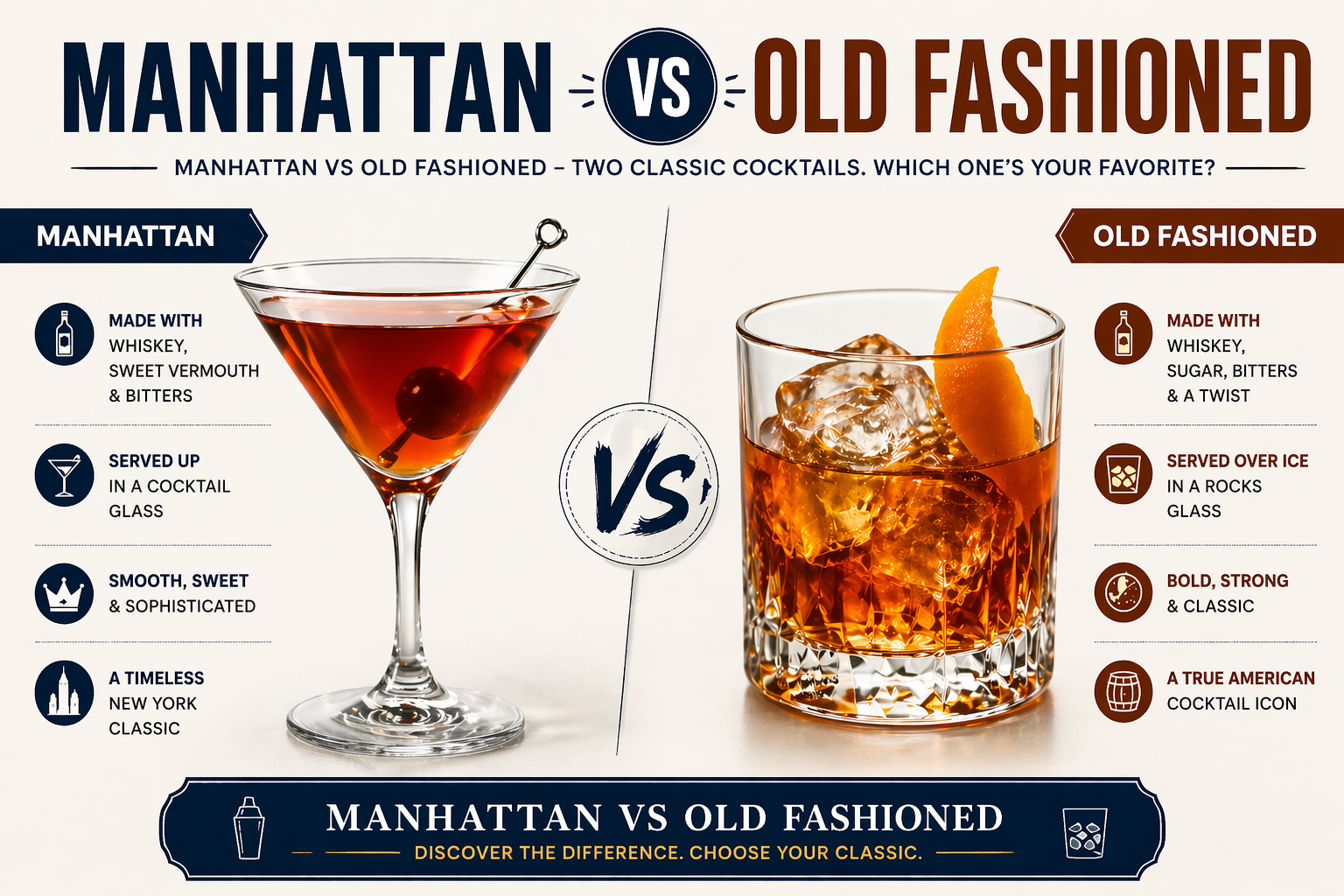
Few debates stir whiskey lovers more than Manhattan vs Old Fashioned. Both are timeless classics, yet they offer dramatically different drinking experiences. Whether you’re a home bartender or a curious sipper, understanding the differences between Manhattan and Old Fashioned will elevate your cocktail knowledge. In this guide, we compare ingredients, taste, preparation, glassware, and history to help you choose your perfect pour.
What Is an Old Fashioned?
The Old Fashioned is often regarded as the first cocktail. It’s a classic drink with a long history. Dating back to the early 1800s, it follows a simple formula: spirit + sugar + bitters + water (from ice). Traditionally made with bourbon or rye whiskey, the Old Fashioned cocktail emphasizes the whiskey’s natural flavors without overpowering mixers.
Classic Old Fashioned Ingredients:
- 2 oz bourbon or rye whiskey
- 1 sugar cube or ½ oz simple syrup
- 2–3 dashes Angostura bitters
- Orange peel or lemon twist (garnish)
- Large ice cube
How to Make an Old Fashioned:
- Mix the sugar and bitters with a little water.
- Add whiskey and ice.
- Stir gently.
- Garnish with citrus peel.
What Is a Manhattan?
The Manhattan emerged in the 1870s, likely at New York City’s Manhattan Club. It adds sweet vermouth to the whiskey-bitters foundation, creating a more complex, herbal, and smoother profile. The Manhattan cocktail is typically served “up” (without ice) in a chilled coupe or martini glass.
Classic Manhattan Ingredients:
- 2 oz rye whiskey (or bourbon)
- 1 oz sweet vermouth
- 2–3 dashes Angostura or orange bitters
- Maraschino cherry (garnish)
How to Make a Manhattan:
- Put whiskey, vermouth, and bitters into a mixing glass with ice.
- Stir until well-chilled (about 30 seconds).
- Strain into a chilled coupe or martini glass.
- Garnish with a cherry.
Manhattan vs Old Fashioned: Key Differences at a Glance
| Feature | Old Fashioned | Manhattan |
| Base Spirit | Bourbon or rye whiskey | Rye whiskey (preferred) or bourbon |
| Sweetener | Sugar cube or simple syrup | Sweet vermouth (adds sweetness & herbal notes) |
| Bitters | Angostura | Angostura and/or orange bitters |
| Muddling | Yes (sugar cube) | No |
| Preparation | Built in glass | Stirred, then strained |
| Glassware | Lowball/rocks glass (with ice) | Coupe or martini glass (no ice) |
| Garnish | Orange peel or lemon twist | Maraschino cherry |
| Taste Profile | Spirit-forward, robust, slightly sweet | Smooth, herbal, wine-like complexity |
| ABV (approx.) | 30–35% | 30–32% |
Taste Comparison: Manhattan vs Old Fashioned
When comparing Manhattan vs Old Fashioned taste, the differences are striking:
Old Fashioned Taste:
- Bold and direct – The whiskey dominates.
- Subtle sweetness – Sugar rounds off the edges without masking the spirit.
- Citrus notes – Orange or lemon peel adds brightness.
- Best for: Those who want to taste the whiskey’s character without distractions.
Manhattan Taste:
- Smoother and rounder – Vermouth adds silkiness.
- Herbal and slightly bitter – Vermouth brings botanicals and wine tannins.
- Drier finish – Less sugary than an Old Fashioned.
- Best for: Drinkers who enjoy complexity and a wine-like influence.
Pro tip: Using rye whiskey in a Manhattan enhances spice notes; bourbon makes it sweeter. For an Old Fashioned, bourbon gives caramel richness, while rye adds peppery bite.
History Explained: Origins of Both Cocktails
Old Fashioned History:
The Old Fashioned history begins in the early 1800s, when a “cocktail” simply meant spirit, sugar, water, and bitters. By the 1880s, drinkers began asking for the “old fashioned” way — rejecting newer additions like vermouth or liqueurs. The Old Fashioned cocktail was formally named at the Pendennis Club in Louisville, Kentucky, and later popularized at New York’s Waldorf-Astoria.
Manhattan History:
The Manhattan history is often traced to a banquet hosted by Lady Randolph Churchill (Winston’s mother) at the Manhattan Club in the 1870s. The drink was an instant success. Unlike the rustic Old Fashioned, the Manhattan cocktail represented urban sophistication — mixing whiskey with Italian sweet vermouth and bitters. Prohibition nearly erased it, but it rebounded as a speakeasy staple.
Which Is Stronger? Manhattan vs Old Fashioned
Both cocktails are potent, but the Old Fashioned typically has a slightly higher ABV because it lacks the diluted wine content of vermouth. However, because the Manhattan is served without ice (and the Old Fashioned melts slowly), the Manhattan can feel stronger upfront. On average:
- Old Fashioned ABV: ~35% (with 2 oz 45% whiskey)
- Manhattan ABV: ~30–32% (vermouth is ~15–18% ABV)
When to Order Each: Occasion & Mood
Choose an Old Fashioned when you want:
- A slow-sipping, contemplative drink.
- Something to enjoy with a steak or cigar.
- Minimal ingredients, maximal whiskey flavor.
Choose a Manhattan when you want:
- A sophisticated, pre-dinner cocktail.
- A smoother, less sweet experience.
- A drink that feels “dressed up” (perfect for martini glasses).
Popular Variations
Old Fashioned Variations:
- Wisconsin Old Fashioned – Brandy instead of whiskey, muddled fruit.
- Oaxaca Old Fashioned – Tequila or mezcal base.
- Smoked Old Fashioned – Infused with wood smoke.
Manhattan Variations:
- Perfect Manhattan – Equal parts sweet and dry vermouth.
- Rob Roy – Made with Scotch whisky.
- Brooklyn – Adds dry vermouth and Amer Picon (or substitute).
Final Verdict: Manhattan vs Old Fashioned – Which Is Better?
There is no “better” — only preference. The Manhattan vs Old Fashioned debate comes down to:
- Old Fashioned = Rustic, bold, whiskey-forward.
- Manhattan = Elegant, herbal, wine-smooth.
If you love bourbon’s caramel notes and a tactile muddling ritual, go Old Fashioned. If you prefer rye’s spice balanced with vermouth’s complexity, order a Manhattan.
FAQ: Manhattan vs Old Fashioned
Q: Is a Manhattan sweeter than an Old Fashioned?
A: No. The Old Fashioned is generally sweeter due to sugar. The Manhattan’s sweetness comes from vermouth, which also adds bitterness.
Q: Can I use bourbon in a Manhattan?
A: Yes, but rye whiskey is traditional because it stands up to vermouth without becoming cloying.
Q: Which cocktail is older – Manhattan or Old Fashioned?
A: The Old Fashioned (early 1800s) predates the Manhattan (1870s).
Q: Do you shake or stir a Manhattan?
A: Always stir. Shaking aerates the drink and creates a cloudy, unappealing texture.
Q: What’s the best glass for an Old Fashioned?
A: A lowball or rocks glass with a large ice cube.
Conclusion
Understanding the differences between the Manhattan and the Old Fashioned unlocks a deeper appreciation for classic cocktails. Whether you prefer the rustic charm of an Old Fashioned or the refined elegance of a Manhattan, both deserve a place in your home bar rotation. Try them side by side — your taste buds will thank you.
