
For income-focused investors, dividend-paying assets are a key part of building consistent cash flow. In recent years, high-yield exchange-traded funds (ETFs) have gained popularity, especially those offering frequent payouts. One such fund is WPAY, known for its weekly dividend distributions and unusually high yield.
This article provides a detailed look at WPAY’s dividend history, including payout trends, yield performance, and what investors should consider before investing.
What Is WPAY?
WPAY is an ETF designed to generate income through a combination of strategies, often including options-based income and investments in other income-producing funds.
Key Characteristics
- Dividend Frequency: Weekly
- Focus: High income generation
- Strategy: Options and yield-focused assets
- Launch Period: 2025
Unlike traditional ETFs that pay dividends quarterly or monthly, WPAY stands out because of its frequent weekly payouts, making it attractive to investors seeking regular income.
Overview of WPAY Dividend History
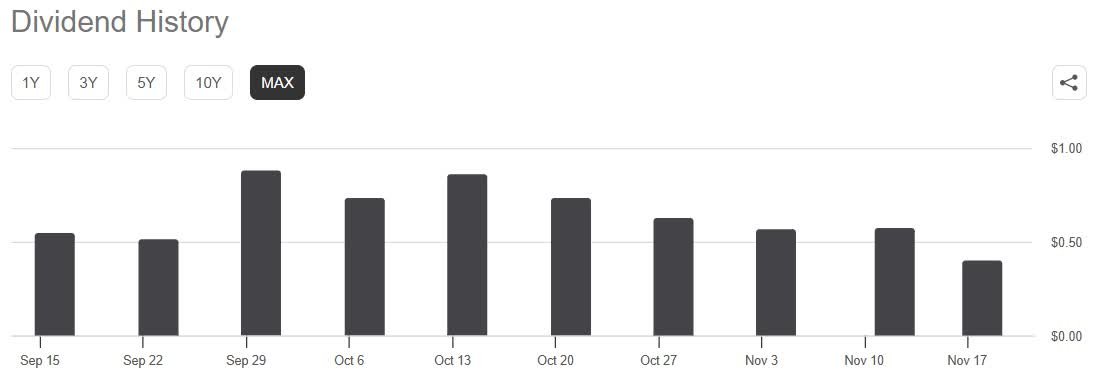
Since its launch, WPAY has maintained a consistent pattern of weekly dividend payments. However, the amount of each payout is not fixed and can vary significantly.
Key Observations
- Dividends are paid every week
- Payout amounts fluctuate based on performance
- Total annual income remains relatively high despite variation
This structure makes WPAY different from traditional dividend stocks that offer predictable and stable payouts.
Early Dividend Performance (2025)
When WPAY first launched, its dividend payouts were relatively high.
Early Trends
- Initial weekly dividends ranged from $0.50 to $0.80 per share
- Some payouts exceeded $0.80, indicating strong early income generation
- High volatility in payouts during the initial phase
What This Means
Early investors benefited from higher-than-average returns, but the variability also highlighted the fund’s dynamic structure.
Recent Dividend Trends (2026)
As the fund matured, dividend payments began to stabilize.
Typical Weekly Range
- Approximately $0.23 to $0.40 per share
- Occasional higher or lower payouts depending on market conditions
Trend Analysis
- Gradual decline from initial high payouts
- More consistent weekly distribution pattern
- Still considered high compared to traditional ETFs
This shift suggests that WPAY has moved toward a more sustainable payout structure, although variability remains.
Annual Yield and Income Potential
One of the most attractive aspects of WPAY is its high dividend yield.
Estimated Yield
- Typically ranges between 25% and 35% annually
- Significantly higher than most dividend ETFs
Example Income Scenario
If an investor holds 100 shares:
- Weekly income: approximately $25 to $35
- Annual income: around $1,200 or more
(Note: Actual returns depend on changing payout levels.)
Why WPAY Dividends Fluctuate
Unlike fixed dividend stocks, WPAY’s payouts are directly influenced by its underlying strategies.
Main Factors Affecting Dividends
1. Options-Based Income
The fund may generate income through options trading, which depends on market volatility.
2. Market Conditions
Changes in the stock market can impact income generation.
3. Underlying Asset Performance
The ETFs and assets within WPAY determine overall returns.
4. Return of Capital
Some payouts may include return of capital rather than pure profit.
These factors explain why WPAY dividends are variable rather than fixed.
Advantages of WPAY Dividend Structure
1. Weekly Income Stream
Investors receive payments every week, providing consistent cash flow.
2. High Yield Potential
WPAY offers one of the highest yields among ETFs.
3. Reinvestment Opportunities
Frequent payouts allow for faster compounding if reinvested.
4. Flexibility for Income Investors
Suitable for those seeking regular income rather than long-term capital growth.
Risks and Considerations
Despite its appealing features, WPAY comes with certain risks.
1. Dividend Instability
Payout amounts can change weekly, making income less predictable.
2. Capital Depreciation
High yields may sometimes come at the cost of declining share prices.
3. Sustainability Concerns
Very high yields may not always be maintained long-term.
4. Complex Strategy
Options-based income strategies can be difficult for beginners to fully understand.
WPAY vs Traditional Dividend Investments
| Feature | WPAY | Traditional Dividend Stocks |
| Frequency | Weekly | Quarterly |
| Yield | Very High | Moderate |
| Stability | Variable | Stable |
| Risk | Higher | Lower |
This comparison highlights that WPAY is better suited for income-focused investors willing to accept higher risk.
Who Should Consider WPAY?
WPAY may be suitable for:
- Investors seeking frequent income
- Those comfortable with higher risk and variability
- Individuals interested in active income strategies
However, it may not be ideal for:
- Conservative investors
- Those seeking stable, predictable dividends
- Long-term capital growth-focused portfolios
Tips for Investing in WPAY
If you are considering WPAY, keep these tips in mind:
- Monitor weekly payout changes
- Understand the fund’s strategy
- Diversify your portfolio
- Avoid relying solely on high yield
- Reinvest dividends wisely
These steps can help manage risk while maximizing potential returns.
Future Outlook
The future of WPAY depends on:
- Market volatility
- Performance of underlying assets
- Demand for high-yield ETFs
- Stability of its income strategy
If managed effectively, WPAY could continue to attract investors looking for regular and high income streams.
Conclusion
WPAY’s dividend history highlights a unique approach to income investing. With weekly payouts, high yields, and dynamic performance, it offers a compelling option for investors seeking frequent cash flow.
However, its variable payouts and higher risk profile mean it is not suitable for everyone. Understanding its dividend trends, strategy, and potential risks is essential before investing.
Overall, WPAY stands out as an innovative income-focused ETF, offering both opportunities and challenges in today’s evolving financial market.
